

Host API reference
This page documents the host API contract that the firmware exposes to plugins.
It is built directly from the canonical header
components/plugin_manager/include/plugin_manager/host_api.h and the WAMR symbol
table in components/plugin_manager/src/WamrImports.cpp.
Every function listed here is both declared in host_api.h and registered in the
symbol table: the two sets match exactly (a clean bijection), so there are no
declared-but-unimplemented stubs. For the full signatures,
parameters and return semantics, generate and read the Doxygen reference.
For the plugin model, manifest schema and lifecycle, see the Plugin SDK & manifest page.
API level
Section titled “API level”The API level constants are defined in host_api.h:
| Constant | Value | Source |
|---|---|---|
HOST_API_LEVEL_MAJOR | 0 | host_api.h:28 |
HOST_API_LEVEL_MINOR | 8 | host_api.h:29 |
HOST_API_LEVEL_STR | "0.8" | host_api.h:30 |
HOST_API_LEVEL_PACKED | (major << 16) | minor | host_api.h:31 |
A plugin declares host_api_level_min in its manifest. At load the firmware
requires the plugin major to equal the firmware major and the plugin minor to be
less than or equal to the firmware minor; otherwise the plugin is rejected with
an API-level mismatch (CapabilityChecker.cpp:44-49).
Return codes
Section titled “Return codes”All fallible host functions return an int status. The codes are
(host_api.h:37-46):
| Code | Value | Meaning |
|---|---|---|
HOST_OK | 0 | Success |
HOST_ERR_GENERIC | -1 | Unspecified failure |
HOST_ERR_INVALID_ARG | -2 | Bad argument (includes failed pointer validation) |
HOST_ERR_NO_CAPABILITY | -3 | Required manifest capability not declared |
HOST_ERR_NOT_FOUND | -4 | Resource or key not found |
HOST_ERR_TIMEOUT | -5 | Operation timed out |
HOST_ERR_NO_MEMORY | -6 | Allocation failed |
HOST_ERR_BUSY | -7 | Resource in use / conflicting claim |
HOST_ERR_NOT_SUPPORTED | -8 | Operation not supported |
HOST_ERR_RMEM_FULL | -9 | Retained-memory pool exhausted |
Functions that return a count or handle return a non-negative value on success
and a negative HOST_ERR_* on failure; handle-returning functions (HTTP, socket)
return a handle greater than zero.
UTF-8 boundary
Section titled “UTF-8 boundary”The whole host API speaks UTF-8. Text passed to UI, canvas and display functions
is converted to the display codepage internally, and text read back
(host_ui_consume_input_text, host_view_canvas_get_text) is returned as UTF-8
(host_api.h:1414-1424). Plugins normally never convert anything themselves.
For message transfer, payload bytes are opaque and not converted; for text MIME
types they are UTF-8 (host_api.h:1336-1339). host_msg_send_interactive and
host_msg_send take a flags argument; passing HOST_MSG_FLAG_PERSIST opts the
transfer into a session-persistent pairing, so repeated sends to the same peer
(e.g. a messenger) confirm the numeric-comparison code only once per power
session. Two optional helpers, host_str_to_display and host_str_to_utf8,
exist for advanced cases such as pre-rendering to a specific codepage; do not
feed their output back into the auto-converting UI functions
(host_api.h:1428-1454).
Symbols and icons
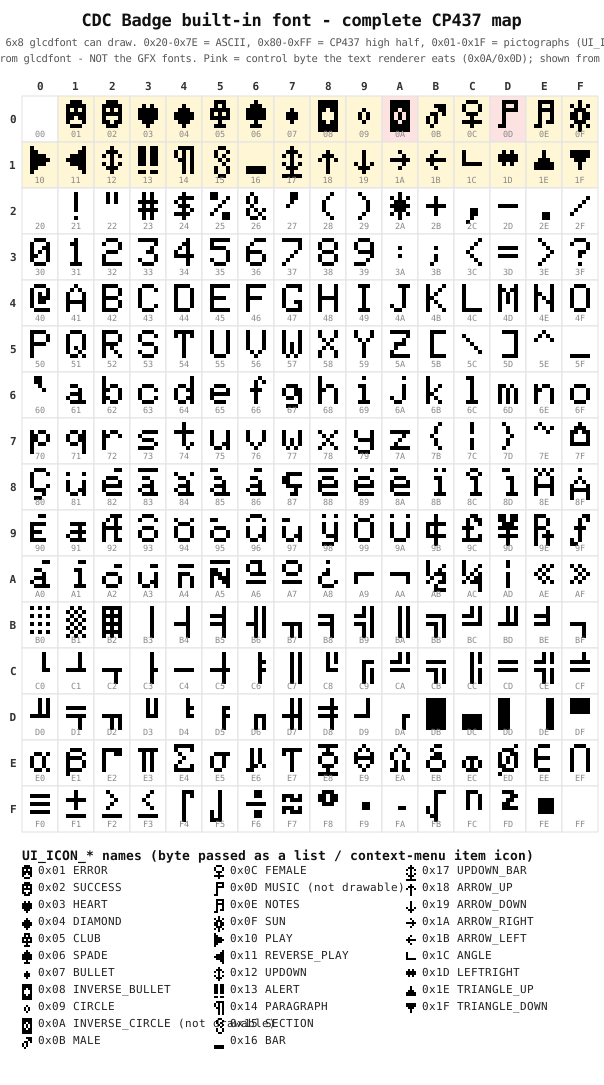
Section titled “Symbols and icons”The display font is the built-in 6x8 Adafruit-GFX glyph set, which is the full
IBM-PC code page 437 (CP437). The two charts below are rendered straight from the
firmware’s components/Adafruit-GFX/glcdfont.c, so they match the panel exactly
(regenerate with python3 tools/gen_symbol_chart.py).
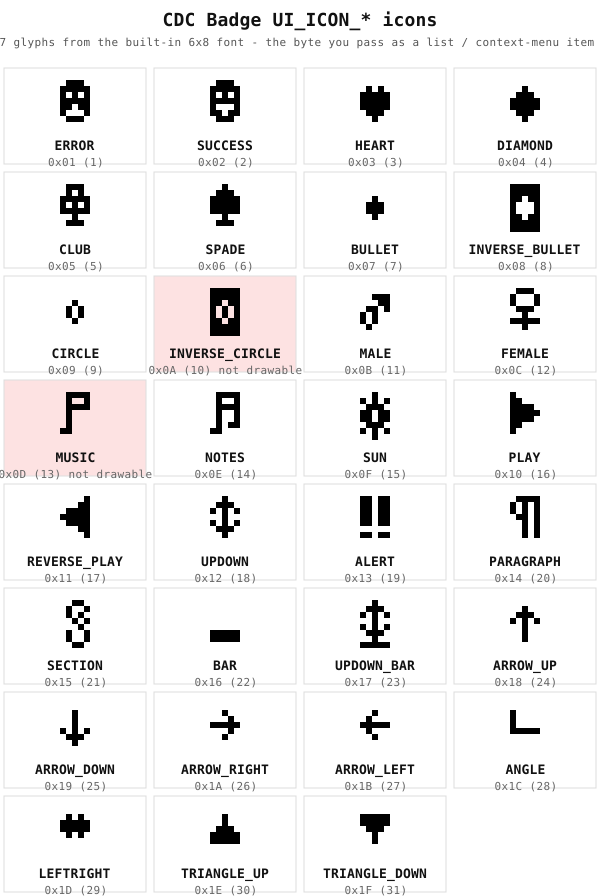
The named pictographs (UI_ICON_*, bytes 0x01-0x1F):
The complete CP437 code page (every byte 0x00-0xFF):
There are two ways to put a symbol on screen:
- As a list / context-menu item icon. Pass the byte in the item’s
iconfield. TheUI_ICON_*names are the CP437 bytes 0x01-0x1F (host_api.h:747-790);UI_ICON_NONE(0) draws a default bullet. Toast / message / confirm views only honor a small fixed icon set (host_api_ui.cpp); other values fall back to no icon there. - In text (UI strings and
host_view_canvas_draw_text). Pass the glyph’s normal Unicode character; the UTF-8->CP437 converter maps it to the right byte (Cp437.cppfromUnicode):♥(U+2665) becomes 0x03,→(U+2192) becomes 0x1A, the CP437 high half (accents, box-drawing, Greek, maths) maps via thekHightable, and ASCII passes straight through. Two pictographs cannot be drawn as text -0x0A(U+25D9) and0x0D(U+266A) - because the text renderer consumes those bytes as newline / carriage-return; they are reachable only as the bitmap shown in the chart.
Function families
Section titled “Function families”Each family is a Doxygen \defgroup in host_api.h with a matching
host_api_<family>.cpp implementation. The table below lists the family, the
manifest capability it requires (if any), and a few representative functions. It
is not exhaustive; consult host_api.h or the Doxygen reference for the
complete set.
The “Capability” column reflects what is enforced at the host-call boundary
(HOST_ERR_NO_CAPABILITY), not just what is documented.
| Family | Capability | Representative functions |
|---|---|---|
| Logging | none | host_log, host_log_hex |
| Time / RTC | none | host_uptime_ms, host_unix_time, host_local_time, host_is_time_set |
| Power | none | host_battery_pct, host_power_source, host_charge_status, host_set_sleep_inhibit |
| Crypto | none | host_random, host_sha256, host_hmac_sha256, host_aes_gcm_encrypt, host_base64_encode |
| SecureElement / TROPIC01 | rmem, ecc (named slots) | host_rmem_read_named, host_rmem_write_named, host_ecc_generate, host_ecdsa_sign, host_eddsa_sign |
| HTTP | http (manifest only, see note) | host_http_open, host_http_set_header, host_http_perform, host_http_read_chunk, host_http_close |
| Socket | socket | host_socket_open, host_socket_write, host_socket_read, host_socket_close |
| Net listener (inbound TCP) | net_listen | host_net_listen, host_net_accept, host_net_close |
| WiFi | wifi (manifest only, see note) | host_wifi_request, host_wifi_is_connected, host_wifi_start_scan, host_wifi_scan_results |
| BLE | ble | host_ble_register_service, host_ble_send_notification, host_ble_scan_start, host_ble_connect, host_ble_subscribe, host_ble_subscribe_char, host_ble_get_mtu, host_ble_on_write_complete |
| NVS (plugin-namespaced) | none | host_nvs_get_blob, host_nvs_set_blob, host_nvs_get_u32, host_nvs_erase_all |
| vFAT (sandboxed files) | vfat | host_fs_write, host_fs_read, host_fs_remove, host_fs_list, host_fs_view, host_fs_view_image, host_fs_view_markdown |
| UI - Views | none | host_ui_push_toast, host_ui_push_list, host_ui_push_t9_input, host_ui_push_confirm, host_ui_pop, host_ui_view_image, host_ui_view_markdown, host_browser_open |
| UI - Canvas | none | host_view_canvas_push, host_view_canvas_draw_text, host_view_canvas_draw_rect, host_view_canvas_draw_circle, host_view_canvas_draw_triangle, host_view_canvas_draw_round_rect, host_view_canvas_draw_line, host_view_canvas_draw_pixel, host_view_canvas_draw_bitmap, host_view_canvas_draw_sprite, host_view_canvas_set_shade, host_view_canvas_add_slider, host_view_canvas_commit, host_view_canvas_elem_begin, host_view_canvas_elem_end, host_view_canvas_elem_set_offset, host_view_canvas_elem_move, host_view_canvas_elem_show, host_view_canvas_elem_remove, host_view_canvas_elem_clear, host_view_canvas_elem_set_z, host_view_canvas_elem_get_offset, host_view_canvas_elem_get_bounds, host_view_canvas_set_anim_policy, host_view_canvas_set_ink, host_view_canvas_marquee, host_view_canvas_clear_ex |
| UI - Canvas animation | none | host_anim_start, host_anim_cancel, host_anim_pause, host_anim_state, host_anim_active_count, host_anim_blink |
| Sprites | none | host_sprite_create, host_sprite_create_from_surface, host_sprite_create_from_image, host_sprite_set_mask, host_sprite_set_flags, host_sprite_set_scale, host_sprite_set_frame, host_sprite_get_frame, host_sprite_set_frame_durations, host_sprite_play, host_sprite_stop, host_sprite_destroy |
| UI - Low-level GFX | display_lowlevel | host_display_width, host_display_draw_line, host_display_fill_rect, host_display_flush |
| I18n | none | host_i18n_tr_key, host_i18n_tr_core, host_i18n_tr_meta, host_i18n_current_language |
| EventBus | none | host_event_subscribe, host_event_unsubscribe, host_event_publish |
| Keypad | none | host_key_pressed, host_key_consume_next |
| USB CDC | usb_cdc | host_usb_cdc_write |
| System Info | none | host_get_firmware_version, host_get_build_profile, host_feature_enabled, host_cpu_load |
| Command channel | none | host_cmd_consume |
| Message transfer | ble + message_types | host_msg_register_handler, host_msg_consume, host_msg_send_interactive, host_msg_send |
| External features | none to call; provides to serve | host_ext_feature_use, host_ext_feature_available, host_ext_feature_register_handler, host_ext_feature_consume, host_ext_feature_result |
| vCard store | vcard | host_vcard_get_own, host_vcard_set_own, host_vcard_received_count, host_vcard_received_get, host_vcard_received_add, host_vcard_received_update, host_vcard_received_delete |
| QR encoding | none | host_qr_measure, host_qr_render_bitmap |
| Image decoding | none | host_image_info, host_image_render |
| Offscreen surfaces | none | host_surface_create, host_surface_draw_text, host_surface_draw_bitmap, host_surface_draw_sprite, host_surface_export, host_surface_export_jpg, host_surface_destroy |
| Lifecycle | background / autoload (opt-in) | host_set_resident |
| Strings | none | host_str_to_display, host_str_to_utf8 |
| GPIO / PWM / ADC / I2C / SAO | gpio_pins / pwm_pins / adc_pins (per pin) | host_gpio_write, host_gpio_read, host_gpio_pwm_start, host_adc_read, host_i2c_write_read, host_sao_eeprom_read |
| Pixel strip | pixel_strip | host_pixel_strip_init, host_pixel_strip_set, host_pixel_strip_fill, host_pixel_strip_refresh |
| Lockscreen quick-action | none (requires an active plugin) | host_lockscreen_register_action, host_lockscreen_alert |
Canvas animation
Section titled “Canvas animation”The canvas has a three-layer animation model, from manual to fully host-driven:
- Elements (
host_view_canvas_elem_*) are named groups of draw commands with a replay offset, visibility and a z layer. Record content once, then move / hide / re-layer it without rebuilding the display list.host_view_canvas_elem_clearre-records an element’s content in place (live counters);host_view_canvas_elem_get_boundsreturns its box for edge and collision checks. - Tweens (
host_anim_*) animate an element’s offset on the host clock: duration, delay, easing (HOST_EASE_*: linear, quad/cubic in/out/in-out, overshoot, bounce, elastic, step), repeat with optional yoyo, chaining viastart_after, and a completion action (plugin_on_action(done_action_id, handle, elem_id)).host_anim_blinktoggles visibility as a one-call convenience. While anything runs the host commits the canvas automatically — no per-frame plugin code. - Sprites (
host_sprite_*) are multi-frame 1-bpp frame sheets (packed rows, MSB-first, frames stacked vertically — the surface/QR/image layout). Sources: a raw buffer, a composed surface sliced into a grid (host_sprite_create_from_surface) or an encoded PNG/JPEG filmstrip decoded and dithered in one call (host_sprite_create_from_image). Draw them by reference withhost_view_canvas_draw_spriteinside an element, andhost_sprite_playadvances frames (once / loop / ping-pong, per-frame durations, completion action). An optional mask plane paints white pixels too; flags flip horizontally/vertically and rotate in 90-degree steps, andhost_sprite_set_scaleupscales 2x-4x — both lossless on 1-bpp.
Two conveniences round it off: host_view_canvas_marquee renders a text once
and scrolls a window through it seamlessly on the host clock (ticker for long
lines), and host_view_canvas_set_ink records white-drawing shapes — an
eraser for wipe transitions and cut-outs over previously drawn content.
Sprites are canvas resources and normally die with host_view_canvas_clear.
A plugin that builds several screens around the same sheets clears with
host_view_canvas_clear_ex(HOST_CANVAS_CLEAR_KEEP_SPRITES) instead: the
assets (frames, masks, flags, scale, current frame) survive, only their
playback stops — call host_sprite_play again after recording the new
screen. Elements, tweens and widgets are dropped either way.
The canvas_demo example (pages 7–9) shows easing comparison, chained
entrances, sprite playback with flip-on-turn, masked sprites over dithered
backgrounds and z-order layering.
Full signatures
Section titled “Full signatures”This page is a map, not a complete signature list. For every function’s exact
prototype, parameters and return contract, build and open the generated
Doxygen reference, which is rendered from the Doxygen comments in
host_api.h.